Friday, 3 March 2017

Module 3 - completed at last

What a trial this has been! However, all is finally finished and I'm fairly happy with the result.
Fig.1
This was my planned design, loosely based on 'my' lizard's tail and eye, and worked in my chosen colour scheme of purple and gold.

Fig.2
It took several attempts to make a pattern which actually fitted and coiled around my neck as I wanted it to do. When I had one I was happy with I cut it out of a piece of my printed fabric which had metallic purple and gold spirals printed onto a black cotton fabric. Once all the stitching was completed I backed this with more mono-printed fabric, this time in purple (see the swatch on the composite board shown in Fig.9).

 Fig.3
The completed collar

 Fig.4
I used several of my hand made cords to simulate the lizard's tail together with beads. The thick wrapped cord has randomly spaced exposed threads and beads along its length.

 Fig.5
The 'eye' side of the collar has three Yorkshire buttons attached, one of them embellished with a spiral of yellow beads. Metallic gold and purple threads were then couched down in a spiralling pattern and seed beads in yellow and purple attached in all the loops of the spirals.

 Fig.6
I buttonholed all around the edge of the piece to neaten the edge and to attach the lining, though with hindsight I wish I had made more of this edge, perhaps by adding some of my cords to make a spiralling edge.

 Fig.7
Fig.7 shows the back of the collar where the two sides meet.

Fig.8
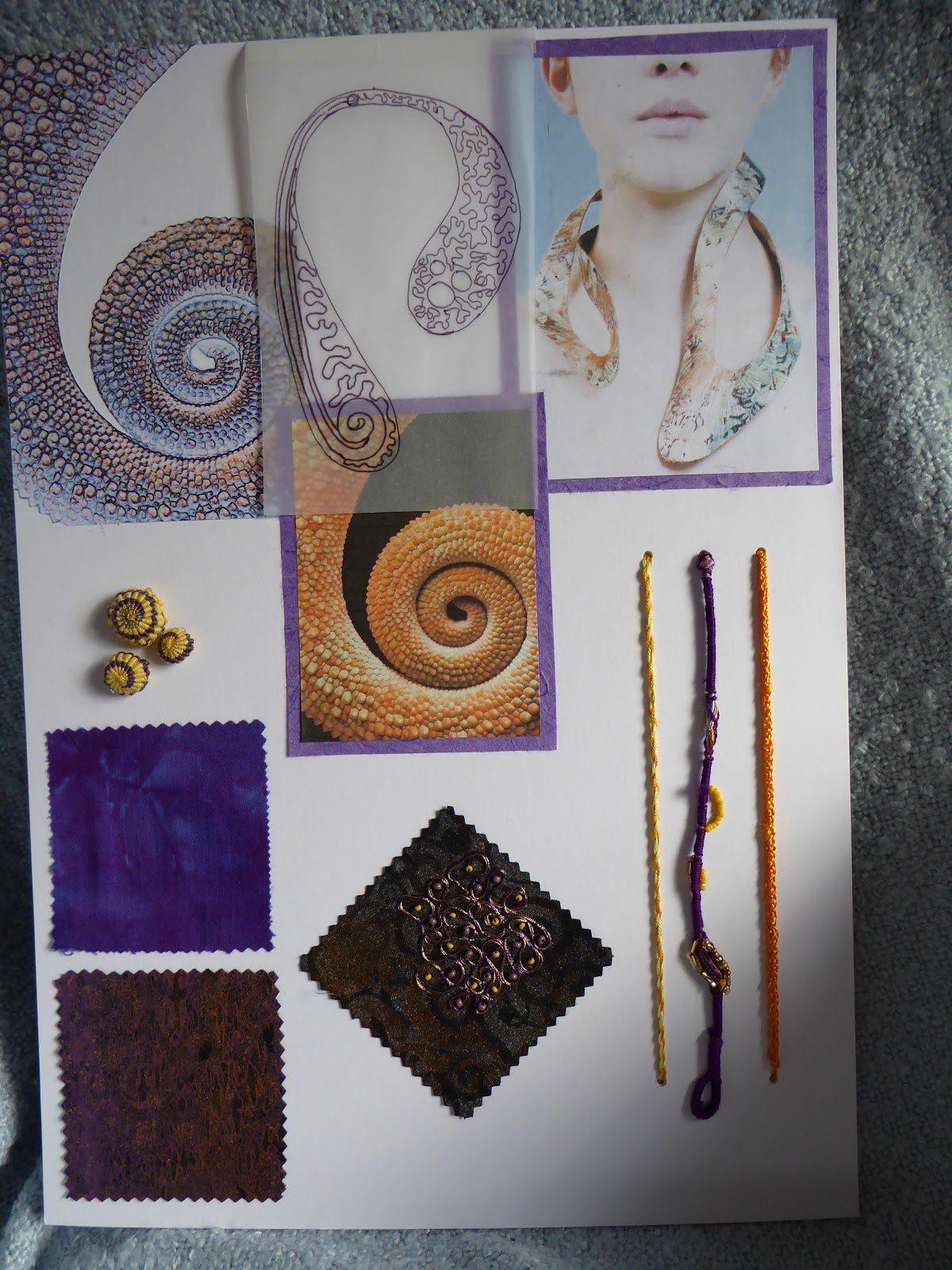
Fig.9
Composite sheet showing my inspiration sources - the metal neckpiece and my lizard's tail, complete with computer manipulated image which inspired the colour choices. I've overlaid a drawing of my design on translucent tracing paper. Examples of the cords and Yorkshire buttons used are included, together with samples of the top fabric, the lining fabric and a sample of the bead embroidery.

Research 3 artists:
Zandra Rhodes
Fig.10

 Fig.11
Deirdre Hawken

 Fig.12

Gustav Klimt
 Fig.13

Timing
Chapter 1 and 2: Research                                    20 hours
Chapter 3: Dyeing fabric                                         8 hours
Chapter 4: Stitching spirals                                     9 hours
Chapter 5: Making cords                                         7 hours
Chapter 6: Making tassels                                       5 hours
Chapter 7: Making buttons                                    10 hours
Chapter 8: Beadwork samples                               15 hours
Chapter 9: Resolved sample                                  20 hours
Chapter 10 and 11: Designing/making accessory  31 hours
Chapter 12: Research three artists                           6 hours
                                      Total for Module 3:      131 hours

Module begun: April 2016; Accessory completed: January 2017 (this bears no reflection to the time actually taken)

Costs
Fabric: 3 metres IKEA curtain lining for dyeing          £4.50
Bondaweb: 1 metre                                                       £3.50
Threads - taken from stock                                          £10.00
Beads - taken from stock                                               £8.00
Procion dyes - taken from stock                                    £5.00
Curtain rings from hardware store (Dorset buttons)     £1.99
Card/mount board                                                         £1.50
Lining paper                                                                  £2.00
Workbook - Pink Pig A4                                               £4.79
                                       Total                                     £41.28

Book list
Creative Embroidery - Jan Beaney and Jean Littlejohn
Designing Worksheets for Textile Students - Jan Messent
Designing with Pattern - Jan Messent
The Embroiderers Workbook - Jan Messent
Machine Embroidery Stitched Patterns - Valerie Campbell-Harding
RSN Guide to Bead Embroidery - Shelley Cox
Decorative Tassels and Cords - Effie Mitrofanis
Dyeing in Plastic Bags - Helen Deighton

Health and Safety
Using Procion dyes:
- Wear a mask and rubber gloves when mixing dyes
- Protect work surfaces and clothing
- Dispose of left over dyes carefully (or use to colour paper for future projects)
Free motion machining:
- Always use correct foot on machine and keep hands on the hoop, well away from the needle
- Take care when guiding cords through the machine while making machine wrapped cords
- Store cords well away from pets
Using hot air gun to make toggles:
- Wear a mask to protect yourself from fumes
- Use in a well-ventilated room
- Have a heat-proof surface to lay tools on
- Take care not to touch hot surfaces
- Allow tools to cool fully before putting away
Beadwork:
- Keep beads away from pets and ensure you don't leave any that have dropped on the floor
General:
Do not allow electrical flexes to trail where they may be snagged or cause a tripping hazard

Storage of work, materials, tools and equipment
As I live alone I have several rooms in my house to work in - one bedroom houses my sewing machine and fabric; the study has my computer, embroidery threads and tools and a comfortable chair for hand stitching and my garage is designated as my workroom for painting, dyeing and other 'messy' activities.
Design work in progress - in sketchbook and marked folders away from sun, dust and liquids in the study
Completed embroidery - in acid free plastic pockets in a folder which houses all my City and Guilds completed pieces
Completed design work - in sketchbook and/or in folders as above
Papers for design work - in folders in the workroom
Inks and paints - upright with lids secured in drawers and plastic boxes in workroom
Glue, bleach etc - upright with lids secured in a cupboard away from pets and children
Embroidery in progress - in a box on the worktable in my study or sewing room (as appropriate)
Fabrics - in boxes according to colour and type in sewing room
Threads - in boxes according to colour and type; wrapped on cards in my study
Beads, metal threads - in boxes on the shelves in my study
Dyes - upright with lids secure in boxes in the workroom
Sewing machine - set up ready for use, covered with its dust cover, in my sewing room
Electrical equipment - in boxes with flexes lightly wound in the workroom

Evaluation
The assessment piece for Module 3 is an accessory based on the design topic of spirals.
I am fairly happy with my accessory in that it is fit for purpose and fulfils the design brief. I chose to make a neckpiece using my lizard as inspiration. (I say 'my' lizard but I don't actually own a lizard. This is the one that I also used as inspiration in Module 2). The resulting piece fits and remains in position when worn. The design I have used relates to the coiled tail and bulging eyes of the lizard and references the colours in one of my manipulated images of the lizard's tail.

If I were to make the piece again I might try to make the piece more fanciful and not keep within the boundaries of the fabric piece I had cut. Perhaps using the wrapped cords as I did when making my little pot in Chapter 7.

I am concerned that I am often too literal in my work and thinking of this brings to mind what Jan Beaney said at Summer School last year about looking for the 'essence' of what attracted you to a subject and exaggerating those aspects in your design, while ignoring others, rather than attempting an exact copy of the original. That is what I have tried to do here by using the manipulated image, but I think I could perhaps have gone further.

Authentification certificate

Friday, 2 December 2016

A sample and a problematic final piece


I'm really struggling to get along with this module- not at the beginning but since summer school. I had another week's holiday almost immediately, my brother came to stay for two weeks, my daughter for a week, my son for a long weekend. There was my exhibition to prepare for, hang and take down a month later, then a week in Wales with my lace tutor and a week in London visiting my son and daughter. And then a cot quilt to be made for my first grandson, due at Christmas. 

All very enjoyable but not at all conducive to getting any kind of prolonged (or even regular) work done on my course. And in the midst of all this social interaction I've lost touch with my initial enthusiasm and ideas.

I have however managed to complete my resolved sample (see fig.1 below). The background is the photoshopped spiral made from the primula in my garden printed onto cotton fabric. The second layer is a representation of a tornado cut from black cotton fabric with painted bondaweb attached. The final layer is a series of thread wrapped bangles, one with a needle woven centre, and Dorset buttons. I've attached a simple mat board frame and allowed the bangles and buttons to come out of the picture and overlap the frame slightly to give a more 3-dimensional feel to the piece.


Fig.1
I had decided to make a neck piece as my final piece for the module so searched online for some images that might inspire me.

Fig.2

I liked the wrap-around one on the left and felt that this might be a design that I could emulate so set about brainstorming some ideas (Fig. 3). I still feel drawn to the lizard from module 2 and felt that this shape could link back to his coiled tail (Fig.4).


Fig. 3


Fig.4

I'm thinking twisted cords, painted background fabric, metallic threads, beads and Yorkshire buttons and continuous spiralling stitching as in chapter 4, sample 3.

Fig.5

I have managed to cut out a template that actually fits around my neck and hangs correctly - after several false starts.

Friday, 23 September 2016

Planning a resolved sample

I'm to make a resolved sample based on techniques, shapes and/or colours already used in previous chapters, using at least two techniques previously used on the course and based on movement. I felt as though I'd rather lost touch with what I was doing with this module so it was very helpful to get everything out and look at it again ... including the previous two modules.

I came up with a list of possible techniques :

  • use of complementary colours
  • patterns using repeating motifs - different sizes; layered (add embroidery and/or beads); cut and separated
  • bonded fabrics (and threads)
  • Fibonnacci - e.g. spiralling log cabin?
  • tones of one colour
  • cords, beads, buttons
There could easily have been more but I wanted to at least try to limit myself to a manageable list.

Fig.1

 I started by playing with a variety of different shapes using the Fibonacci sequence. The only trouble with this is that the numbers very quickly become too large and unwieldy - but worth bearing in mind.


Fig.2
 I was attracted by the meteorological photograph of a tornado from my original research images and looked for more tornado images online.
Fig.3
Then I printed out one of the Photoshop images I had done earlier and used that as a background for a spiral of circles and rings in decreasing sizes. I'm thinking that these could be made of wired cords, buttonholed rings, Dorset buttons and beads in my sample. 

Sunday, 18 September 2016

Chapter 8: Beads, beads and more beads!

This chapter was all about finding how many different ways I could stitch with beads. The answer, I found, was ... a great many, and how much fun it was playing with beads!

Fig. 8.1

I began with some of the suggestions in Sian's notes, so, reading from left to right across each row ...
Top row: 
1. Compact area of one type of bead
2. A compact area using two types of beads (bugle and seed)
3. Lightly sprinkled seed beads
Centre row:
4. Lines of beads using one type of bead
5. Lines of beads using more than one type of bead
6. Lines of sequins
Bottom row:
7. A pattern formed of bugle beads
8. A pattern using three types of bead
9. A large flat bead (actually a washer) trapped under organza with seed beads 'piled' in the centre and scattered around the organza to hold the washer in place.
Around the edges:
A variety of edgings and fringes.

Fig. 8.2

I hadn't run out of ideas so I made another sample. Again, reading from left to right across each row
Top row:
1. Lozenge shaped beads attached with four stitches
2. Circular beads attached with bullion loops
3. A sample of square stitch (which looks like loom work but isn't)
Centre row:
4. Piles of 2, 3 and 4 beads
5. Pairs of bugle beads tied with a cross stitch
6. Beads made from peyote stitched seed beads - a little fiddly to join together but quite effective.
Bottom row:
7. Feather stitch using beads in two different ways
8. Herringbone stitch using beads, again in two different ways
(I could have gone on almost for ever using beads to form embroidery stitches but stopped after these two)
9. A spiral of seed beads
Top edge:
Clusters of seed beads used as edging
Right hand edge:
Loops of seed beads used as edging
Bottom edge:
Horizontal netting fringe
Left hand edge:
Strings of seed beads with a leaf bead in the centre used as an edging.


Friday, 16 September 2016

Chapters 5-7: Cords, Tassels and Buttons

These three chapters were addictive and I did feel as though I could have gone on and on adding more and more samples but time pressures demanded that I stop so I've added a selection here to show the various types of each that I played with.

Fig.5.1

I'm hoping that you are able to see the different types of cords here. From left to right and ignoring the numbers you can see on some of the samples ...
1. The thick orange cord on the very left hand side of the photograph is a twice twisted length of sari ribbon.
2. Next come two machine wrapped cords made from organza strips (yellow) and sari ribbon (purple)
3. A chunky weight wool machine wrapped with some areas left unwrapped to give added texture.
4. Two twisted cords - the yellow one on the left is stranded cotton and the bi-coloured one is a shiny chainette thread.
5. Next (actually marked 5 on the photograph!) are two plaited machine made cords. The left hand one of the two is a normal three stranded plait while the thicker one has four strands. I did struggle to get my head around how to plait more than 3 strands but once I got into the swing of it I thought I might actually go on and see if I could manage even more than 4.
6. Next is a bundle of three knotted cords. The first of these is made up of two machine wrapped cords which have been knotted together at random intervals. The second has been knotted in such a way that the cord twists around making a lovely spiralling cord. The third is made up of three machine wrapped cords which was supposed to be the double ridged hitching cord but I'm not at all sure that I did it correctly. Mine has turned into a lovely wide flat braid however. 
7. A wrapped cord with chunky beads added into the wrapping at intervals and also with some gaps left in the wrapping to expose the core threads which are of a contrasting colour.
8. (Marked 8 on the photograph too) is a cord made using a Lucet using the metallic chainette thread again.
9. These last two braids heading out to the right of the photograph are made on cording discs. The thicker of the two has produced a spiralling pattern with the use of the two colours of cords.

Chapter 6 - Tassels
Fig. 6.1

This time I think that the numbers on the page are easier to see so I'll use those to explain how each tassel was made.
1. A wide machined tassel using metallic machine thread.
2. A narrow machined tassel using the same thread as before.
3. A simple tied tassel using two colours of metallic machine thread.
4. A tassel made with stranded cotton with a buttonholed cap.
5 and 6. are silk cocoons decorated with beads with strings of beads as the tassel strands.
7. A decorated silk cocoon cap with variegated kinked rayon thread body.
8. Silk yarn bound with a strip of silk cocoon decorated with beads added to hide the binding threads.
9. Tubular yarn tassel with buttonholed plastic curtain ring as a header.
10. Soft silk yarn tassel bound, buttonhole lace added over the binding to hide the threads. Then four smaller tassels simply bound were added around the base of the buttonholed binding to make a tassel worthy of being a curtain tie back!
11. The header of this final tassel is a small cotton ball covered with buttonhole lace. The tassel itself is simply bound to hide the join with the header.

Chapter 7: Buttons

Fig. 7.1

Sample 1 is a series of Dorset buttons of various sizes and designs. I was pleased to have worked out how to make the spiral design in the larger two buttons.
2. The beaded top of a silk cocoon.
3. Fabric toggles with buttonholed ends and beads wrapped around them.
4. Toggles made from Tyvek - some with wire and beads added.
5. Toggles made from paper.
6. Embroidered and beaded buttons made on metal self-cover button bases.
7. Mountboard shapes covered with fabric and beads.
8. Yorkshire buttons. These, as the caption says, are made on a card template with notches around the edge and are definitely addictive!. I love the fact that they look like sea urchins.

And then finally ... because I couldn't resist experimenting a little ...


A little vessel made from a several strands of a thick silk yarn which I machine wrapped to make a cord and then spiralled around whilst binding it to make a little vessel. It is actually quite sturdy but small though the technique obviously has lots of potential for making larger vessels. 


Wednesday, 14 September 2016

Chapter 4 - Spiralling into stitch

You'll know by now why it's taken me so long to get around to blogging my progress on my course. I have been working away at it in the background but the work for the exhibition just had to take precedence for a while. Add to that summer school (more of which later), a holiday in the Cotswolds and over three weeks of family visiting the summer has just shot by. Finally I feel like I can try to get back on top of things but it is taking a little while to get into a proper routine again.

And so ... Chapter 4 and I'm stitching again!

Fig. 4.1

I always head for the needle and thread first and these samples were actually worked whilst I was in London visiting my son. In case you aren't able to see the caption to the top piece ... From the outside row 1 is double wrapped running stitch in two colours of space dyed rayon thread. Row 2 is chain stitch using two strands of stranded cotton. Row 3 is thick silk yarn couched with space dyed rayon. Row 4 is french knots in cotton perle 16 thread and Row 5 is feather stitch using two strands of stranded cotton.

Fig. 4.2

I stitched the large sample in my hand without a frame and prior to mounting it in my sketchbook the spiral centres formed little peaks. A lovely textured surface.

Samples 4 and 5 are more needle lace spirals with beads added to accentuate the spiral.

Fig. 4.3

Machine stitch for samples 6 (ordinary straight stitch) and 7 (whip stitch). I have to admit that these were actually quite fun to do and there is more machine stitch in my samples from Summer School.

Fig. 4.4

Sample 8 is a piece of hand-dyed scrim which I stitched on the machine using a spiral movement. Some of the resulting holes were then outlined with buttonhole stitch. I love the delicate feel of this piece though I'm not yet sure how I might use it in a final piece of work.

Sample 9 has woven spirals worked on random wrapping on a cheap wire bracelet. They look almost rose like.

Fig. 4.5

Sample 9 is a spiralled machine made cord couched down in some places with a contrasting thread. I love the three-dimensional nature of this sample and also the non-uniformity of the cord.

I'm adding some of the pieces I did at Summer School here because I based my work there on this module.

Fig. 4.6
Jean asked us to bring a black and white photograph for inspiration to her first session and I had chosen a photograph I took of the 'gherkin' office building in London as the spiralling pattern of the windows attracted me and fitted with my theme.

Fig. 4.7
 We had to continue the lines from our photograph onto the opposite page of our sketchbook to make a rough design.

Fig. 4.8
We then placed scraps of fabric and lengths of thread in a soluble fabric sandwich (sticky soluble on the bottom and transparent on the top) and then machine stitched them together.

Fig. 4.9
When I got home I tried a variation on this theme using a technique which Jan had told us about and this time just laid threads between the two layers of soluble fabric. I then stitched through each join by hand adding a tiny glass seed bead at each junction and leaving thread tails on my stitches. It produced a very soft and unstructured piece of lace! It's a technique I may well return to in the future.

Fig. 4.10
Another experiment - laying pieces of glue covered string down onto plastic and leaving it to dry overnight before adding machine stitch once the piece was sandwiched between the two sheets of soluble fabric.

Fig. 4.11
 I did this piece when I got home - again playing with the soluble fabric sandwich but this time laid spirals of silk fabric between the two and then machine stitched them together. I needed to take more care to ensure that I had caught them all with my stitching than I did however and needed to make some running repairs by hand once the soluble was dissolved away. I'm definitely hooked on the soluble fabrics though and will certainly be using them again in the future!

Fig. 4.12

Jan had us making up designs from a photograph - looking at the essence of what had attracted us to the image in the first place rather than slavishly copying it. I had used a photograph of a little purple snail on a yellow flowering plant for this design which was then drawn onto TAP paper using PITT brush pens and transferred onto soluble fleece before hand stitching onto a fine net. This was such a valuable exercise and I learned a great deal from Jan's design tips.


Thursday, 9 June 2016

Chapter 3: Fabrics and threads

The aim of this chapter is to organise my fabrics and threads in my chosen colour scheme. Looking through my stash I was actually quite surprised to find just how much I already had. OK, to be honest I was more than a little shocked by quite how much purple I found there!

 Fig. 1

Fig. 2
 
 Fig. 3

Fig. 4
 
 Fig. 5

 Fig. 6

Fig. 7

There was slightly less of the yellow spectrum but still, quite enough. I've included photographs of the relevant parts of my bead collection too in the above photographs, along with some metallic threads (I do love a bit of bling and have attended a couple of goldwork workshops in the past - my favourite by Llinos Spriggs, shortly before she sadly died, so count myself very fortunate indeed, but that does account for why I own quite so many beads and metallic threads).

 Fig. 8

I had never used Procion dyes before so sent off for a starter pack from Colourcraft and spent several very happy days with those and Helen Deigham's book.

Fig. 9

The results of the purple are slightly disappointing though I have since bought a pot of purple dye and have overdyed a couple of the more cerise coloured samples in Fig. 9 and am now much happier with the colour. All the fabric pieces were just scrunched up randomly and I shall be printing onto some of these with my gelli plate.

 Fig. 10
This piece (Fig. 10) is not quite as pink in real life as it appears to be here and I overprinted it with bright yellow fabric paint through a stencil, both positive and negative images. I'm really pleased with the result of this and shall certainly use the technique again as it would not only make an interesting background for stitch but also just as a fabric for a sewing project in the future.
 
Fig. 11

Figure 11 shows another experiment with my spiral stencil where I sprayed through the stencil with a yellow shimmer Brusho spray. The yellow has actually sunk into the fabric (which looks quite brown on the reverse) and left behind the shimmer on the surface. I love the effect of this even though it isn't yellow and plan to use this for one of my stitched samples in the next chapter, when I shall use yellow threads to stitch into it.

Fig. 12
I dyed some muslin, scrim and silk pieces too, though only seem to have taken a photograph of the muslin (Figure 12) for some inexplicable reason. These I wet first then dipped just one end of the fabrics into a coffee jar filled with my dye solution to see how the colour might wick up the fabric. It is interesting to see how the colour has separated out as it did so so that the end of the muslin furthest from the dye is actually pink, rather than purple. The end that was in the dye, however, is a very pleasant berry shade. The dye didn't wick up the scrim at all but the section of that fabric which was in contact with the dye is a very dark purple (which is the colour I was actually expecting for them all). The silk on the other hand did soak up the dye but the end that was not in the dye is a bright cerise colour. All very interesting!!!