Monday, 6 May 2019

Chapter 10B: Wallhanging samples

The next task in producing my wallhanging was to enlarge the A3 design to the final size of A1. Not as easy as I thought!! I confidently took my design into town to the print shop ... only to find that the print shop had disappeared!! None of the shops or the library were able to photocopy anything larger than A3. So ... I had two photocopies made - 1 x A3 and 1 reduced to A4 for my presentation board. Back home I took my A3 copy and cut it into 8 pieces. I then enlarged each of these on my own printer to A4 size and taped them all together. The resulting design is almost, though not quite A1 size but near enough for me to work out sizes for each piece of embroidery. The only problem now being that all that photocopying and enlarging has muted the colours considerably but I will refer back to my original papers for my stitching.

Moving on ...

We were then tasked with producing three samples for each paper used in the design. However, due to the large number of papers I used (10 in all) I quickly realised that once translated into embroidery this could end up looking very 'bitty' and took the decision to limit myself to just four types of embroidered pieces.

Fig. 10B:1

This photograph shows two methods for stitching the 'fire' sections of my wallhanging. The fabric I used is the lining of an old umbrella which was printed with Turner's 'Fighting Temeraire'. In the left hand piece I simply stitched across the flame shaped negative spaces. The fabric has formed a rather interesting texture in the process.
The little flame shaped piece on the right is formed by sandwiching three of the flames cut from the first piece between a sticky water soluble fabric and a piece of Romeo soluble film. I purposely didn't rinse all the film out so the threads are still a little firm and the fabric has again buckled. I really like this sample and would like to use this towards the centre of the wallhanging. My only concern is whether it would be considered too figurative?
 

Fig. 10B:2

My third 'fire' sample is worked on scrim with flame shapes stitched on top in a shiny yellow viscose thread. I'm aware that this doesn't show up too well in the photograph but in reality is quite effective. Because it has not been attached to any soluble fabric it has produced a lovely soft fabric which would be very easy to manipulate and stitched onto different colours of scrim (see images below) would, I believe, satisfy the need for different shaded areas without using totally different embroidery methods.
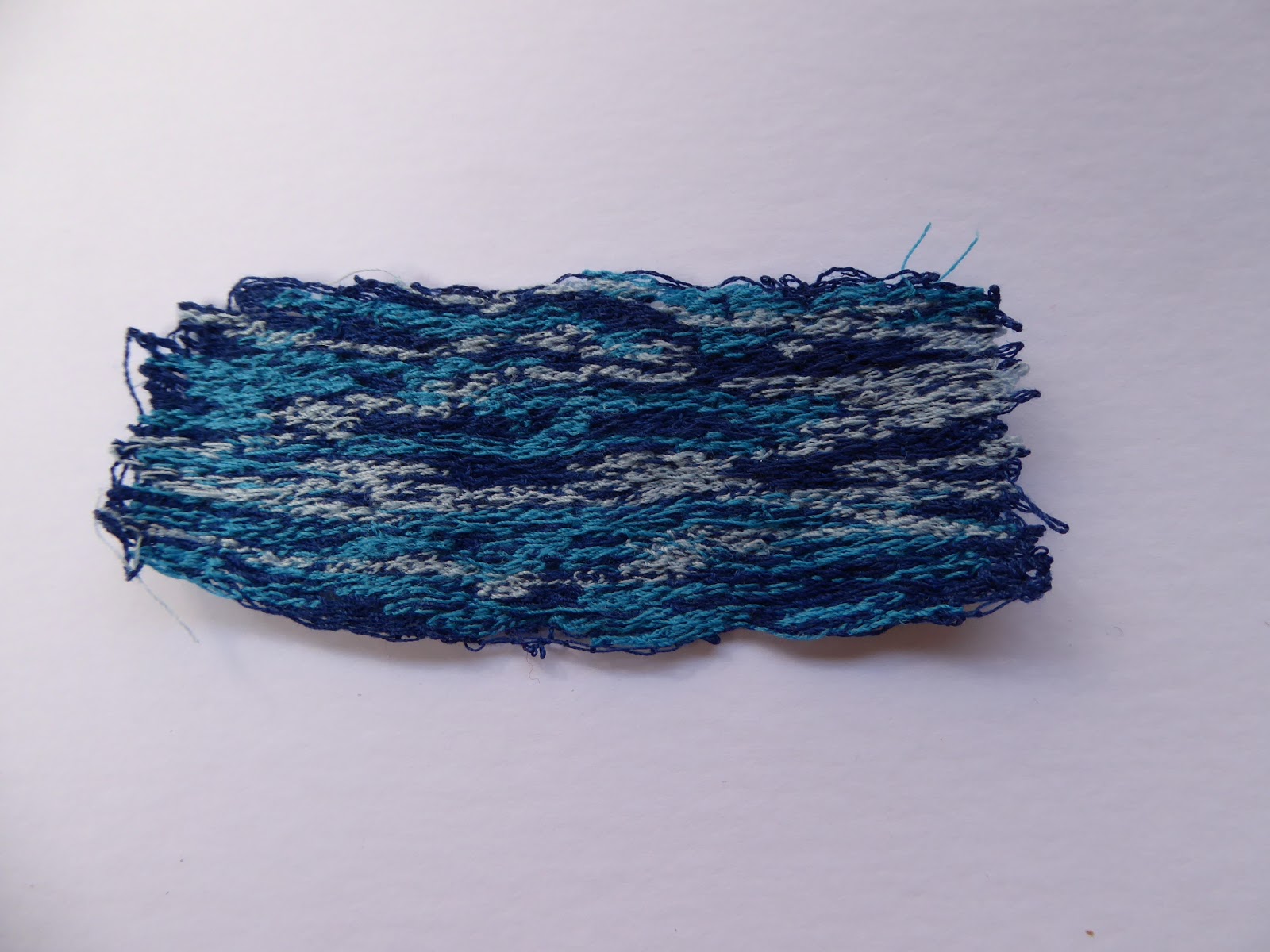
Fig. 10B:3

I stitched this solid piece of machine embroidery on a piece of soluble fabric to mimic the very bottom 'flood' strip in my design, which I think it does adequately, however the remainder of the wallhanging really needs to be more 'ethereal' and flexible so I would not choose to use this.

Fig. 10B:4

Because I liked the 'fire' sample stitched on scrim I returned to this for my next sample (10B:4). Having stitched over the scrim to open up the weave I then stitched waving lines in white thread across the entire piece. I like this but decided it as maybe a little too subtle.

Fig. 10B:5

... so I returned to the pure machine embroidery on soluble fabric and then stitched the wavy lines in cable stitch using a thick cotton thread. This is a definite possibility!!

Fig. 10B:6

Sample 10B:6 is stitched on totally the wrong colour of scrim to reflect the flood waters in my inspiration photograph but I only have a small piece of grey/pale blue scrim left (again, see images below) so decided to save that for the final wallhanging if necessary. I decided to try to get some texture into the 'flood' side of the piece so crumpled a piece of scrim onto the adhesive soluble fabric, covered it with a piece of non-adhesive soluble and stitched circles in a grey thread. Another possible winner which would mimic the movement of the flood water.

Fig. 10B:7


Fig. 10B:8

Fig. 10B:9

I decided to try for more movement by first stitching a piece of just embroidered circles (Figl 10B:7), and then a piece of scrim with holes cut into it (Fig. 10B:8). I used a dark grey thread on this second piece to better mimic the flood waters though would probably use the grey scrim for the final piece.

I had been thinking about how to join all these pieces together and decided that merely joining them with insertion stitches would make it tricky to get them to hang properly so went out and bought a piece of grey net. I crumpled and stitched these last two samples onto a piece of  the net fabric to see how that would work. It does indeed work and the net blends into the background so from a distance the pieces of embroidery should look as though they are floating in air.

I have decided to use scrim as a background for all my embroidered pieces to make a co-ordinated whole... samples 2, 4 (with the cable stitch wavy lines rather than machine cotton) and 6. The black square in the centre of the design will also be solidly stitched onto a piece of scrim. The only exception to this 'rule' would be the addition of a small number of the flame shaped pieces added on top of some of the 'fire' areas of the design if this were not deemed to be too figurative. (I await advice on this point).

As a result of this decision with regard to fabric I have gathered together a selection of scrim pieces in relevant colours hand dyed for various pieces of work during this course and for earlier projects. I would certainly not envisage using every piece but there are certainly areas of many which could appropriately be used.

Fig. 10B:10 - heart of the fire

Fig. 10B:11 - smoke and edges of the fire
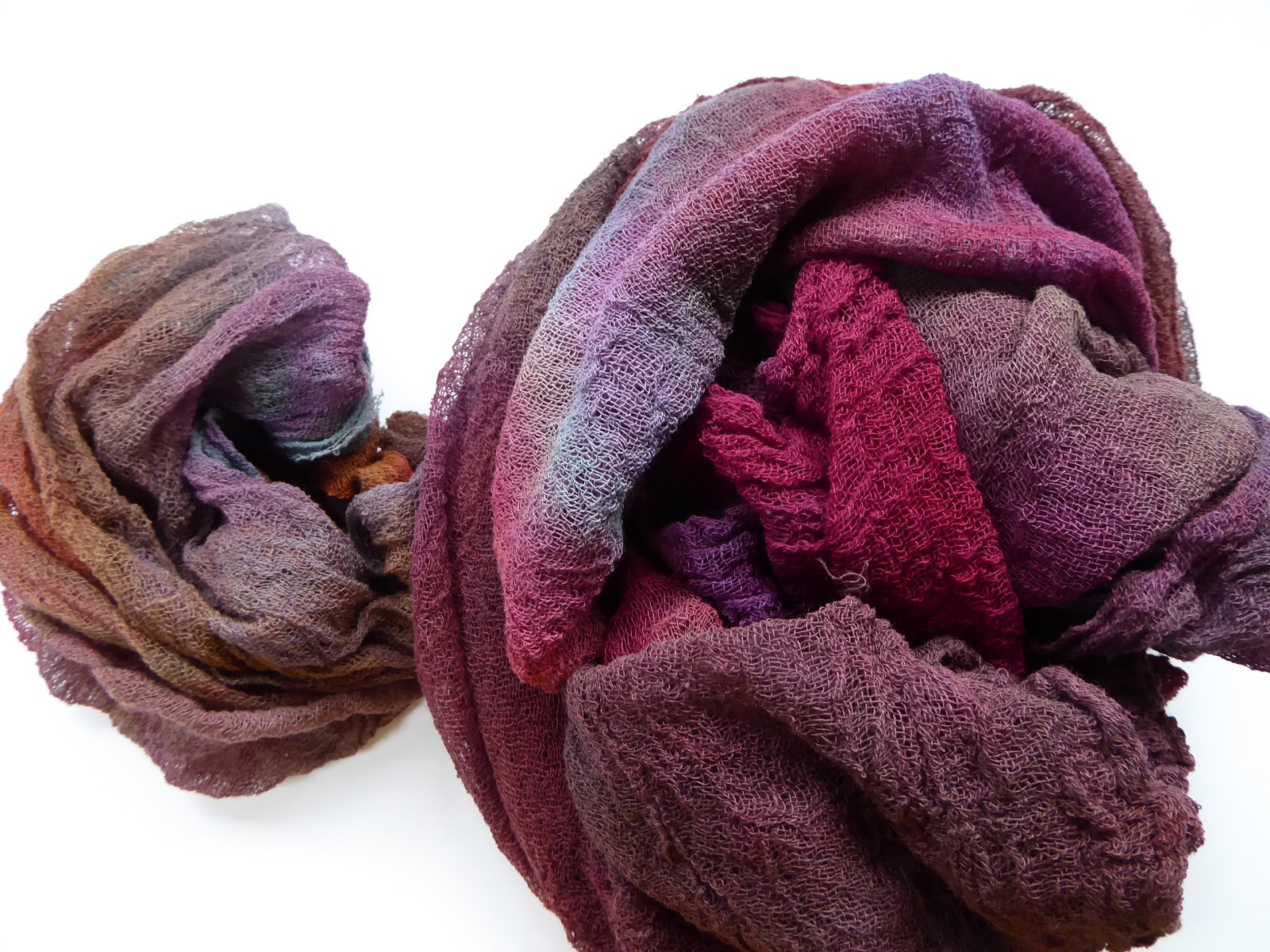
Fig. 10B:12 - possibly some areas of smoke near the top of the piece

Fig. 10B:13 - the grey on the left for the flood water. The turquoise is not really appropriate

Fig. 10B:14 - centre black square

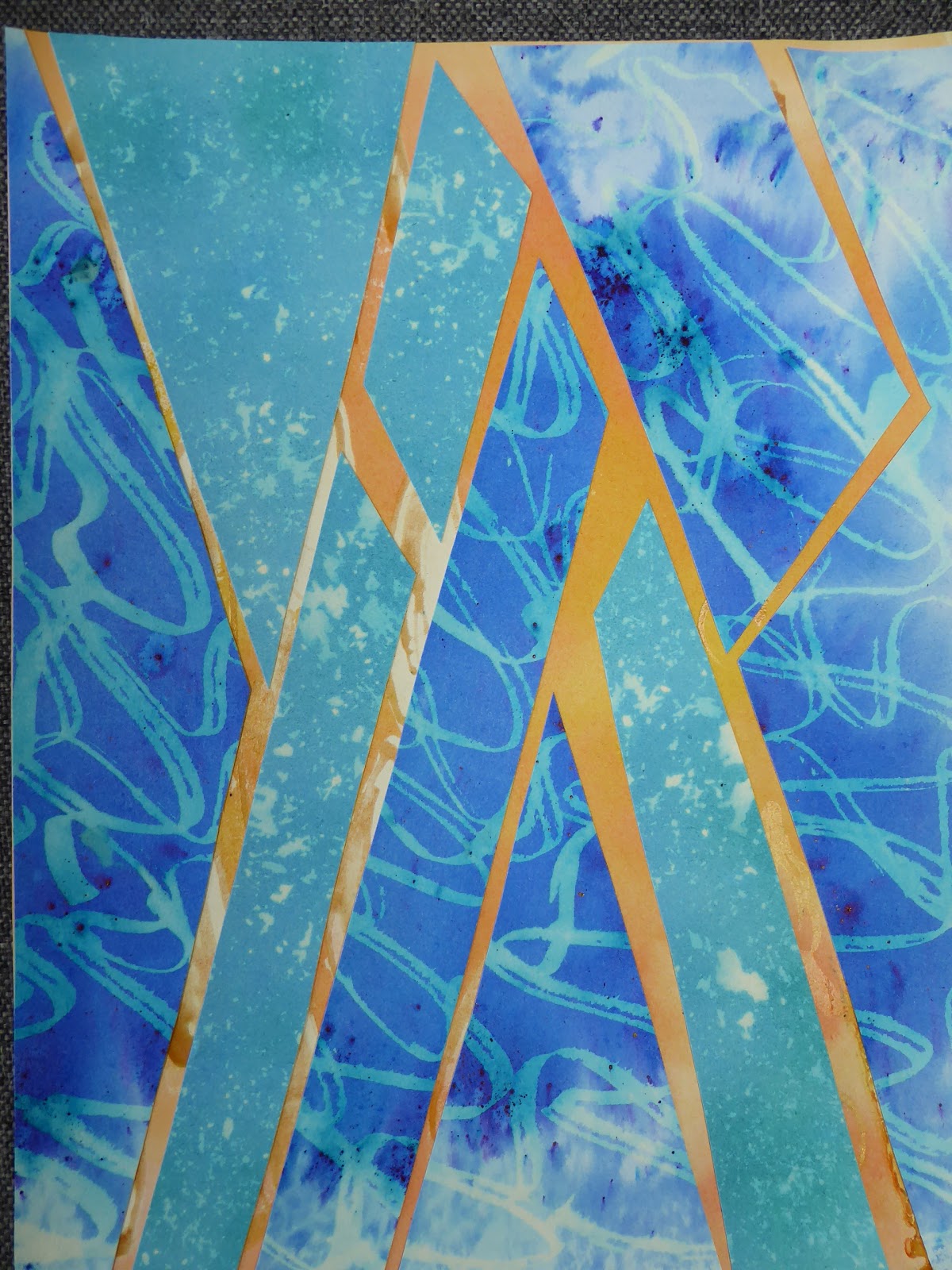
Sunday, 14 April 2019

Chapter 10: Three designs

We were then asked to choose three of our small designs to enlarge to A3 size in a bid to choose one to take forward to the final piece. I chose Nos. 1, 4 and 5 of the colour designs from Chapter 8. I have stuck largely to a palette of blues/turquoise and orange/reds. Where you see white on the images below this would actually be open space between the pieces of fabric.

Fig. 10:1: Iceberg calving

I see this being stitched using a reverse applique technique with each layer being covered with machine embroidery. I have kept the design to three layers as I think that more than that could be difficult to manage and confusing to the viewer. I believe it would make an attractive large scale wall hanging which would be quite easy to display due to its robust construction. I also think that the design, although abstract, does successfully convey the message of global warming.
 
Fig. 10.2: Shattered

I liked this design in the smaller version but like it less at this larger scale. Maybe that is due to the larger number of papers used, which have made it more confusing I think. I imagined this being constructed from lacy fabrics made on soluble fabric with no backing. The four side panels would hold it in place while the centre triangles, although joined to each other and to the edging strips, would be free to move more fluidly. This would emphasise the fragility of the polar ice caps, with the red/orange pieces representing the global warming. To my mind, this is the weakest of the three designs chosen.
 
Fig. 10.3: Twin threats 

This is my favoured design, for two reasons. Firstly, as it represents the twin threats to the countryside and villages near where I live ... the regular flooding and the moorland fires, so making it a more personal issue than the other two. The second reason is rather more pragmatic. A textile group of which I am a member is holding an exhibition next year entitled 'The Pennines' so this piece could potentially be displayed there.
Again, I see this being made mainly of strips of lacy fabric, either stitched on soluble fabric or onto translucent chiffon or scrim. I was a little loathe to use the 'log cabin' construction suggested in the course notes but do feel it offers the best method of making this design into a wall hanging. The strips would be held together with insertion stitches which would leave them free to move like the flames represented by the red/orange fabrics, and indeed also the movement of the flood waters represented by the blues.
I made the central block black to represent the fear, despair and ultimately death of the wildlife trapped on the moor.

Chapter 9: Colouring papers

As always, the design process begins by colouring papers. I made quite a collection, most of which I haven't actually used in my three chosen designs, but they will add to my stash for future use.

Fig. 9.1: Greens

Fig. 9.2: Yellow/oranges 

Fig. 9.3: Oranges/reds

Fig. 9.4: Blues

Fig. 9.5: Turquoises

I painted with brusho, acrylic paint, bleach and acrylic inks using some handmade stamps of flames and wave patterns to link them to my theme of global warming.

Sunday, 17 March 2019

Chapter 8: Research

Two main conservation themes dominate the news currently ... plastic pollution and climate change. I had been intending to focus on the former but have come to realise that I have no desire to stitch through plastic on my sewing machine (though I feel sure it could easily manage it - I simply wouldn't enjoy the process). Nor do I relish the thought of having a wall hanging in my home which contains plastic. As a result I have opted to focus on climate change and the effects that is having on our oceans and weather systems.I live in the Pennines and we regularly feel the effects of climate change with floods in nearby towns and the increasingly frequent moorland wildfires, so this is also relevant to my local environment.

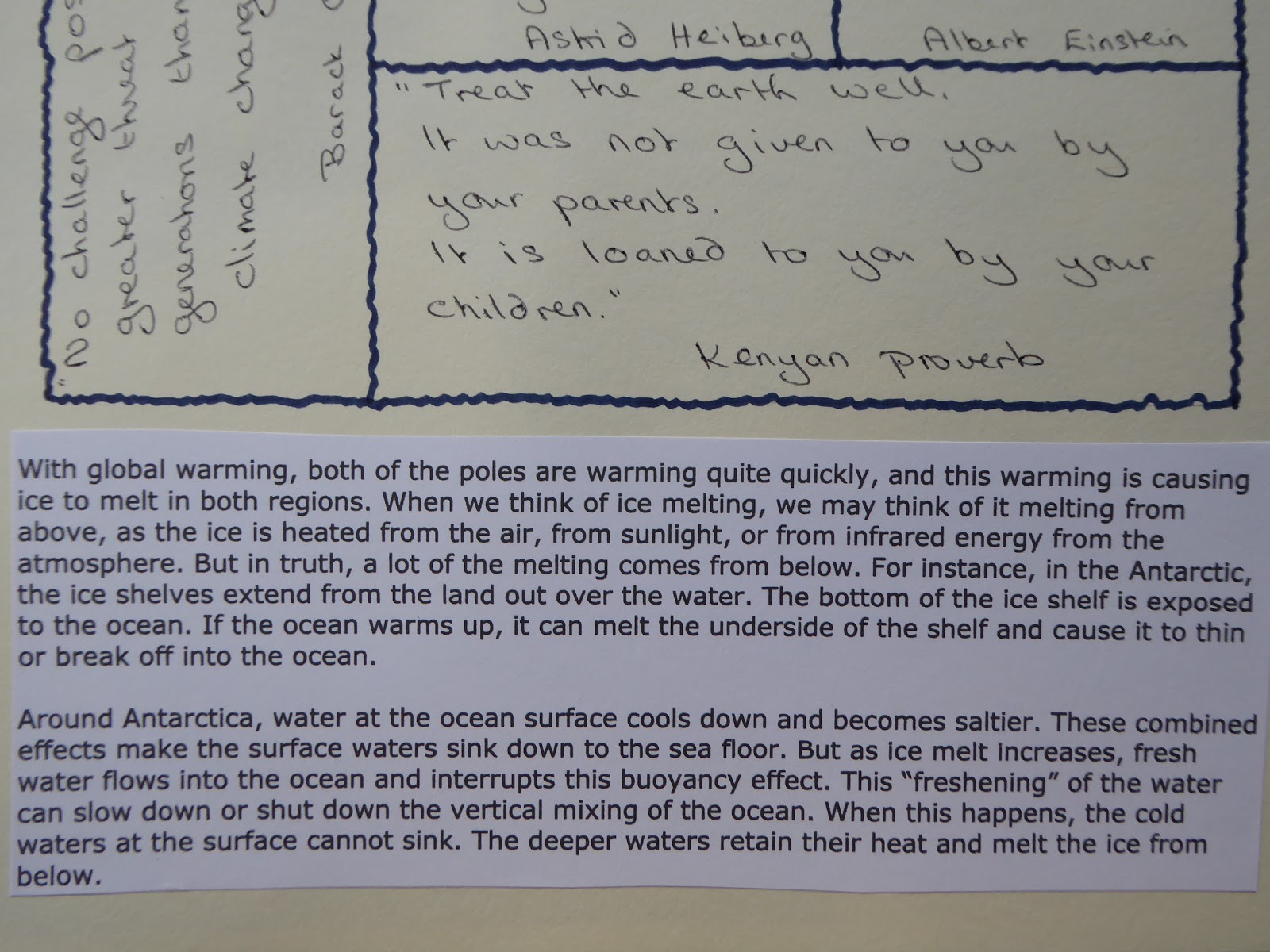
I began my research, as I usually do, by searching for quotes:


Fig: 8:1

Conservation ... according to my dictionary ... is the act of conserving, or keeping from change, loss, injury etc and also protection, preservation and careful management of natural resources.

“Climate change has happened because of human behaviour” “We are the first generation to realise that we are killing our planet and the last generation to be able to stop it.” Francois Holland’s said “We have a single mission ... to protect and hand on the planet to the next generation.” “We have to wake up to the fierce urgency of the now” “Future generations will judge us harshly if we fail to uphold our moral and historical responsibilities.” Astrid Herbert says “Climate change is no longer a doomsday prophecy, it’s a reality.” Barack Obama said that “No challenge poses a greater threat to future generations than climate change.” Even Albert Einstein commented on the problem “We shall need a substantially new way of thinking if humanity is to survive.” I particularly like this Kenyan proverb, which I now have pinned up on my kitchen noticeboard: “Treat the earth well. It was not
given to you by your parents. It is loaned to you by your children.”

Fig: 8:2

These two paragraphs in Fig. 8.2 explain exactly what is happening to our planet.


Fig: 8:3

Fig: 8:4
Figs. 8.3, 8.4 and 8.5 show pages of research from my workbook. The focus highlighted in recent news stories is to limit global warming to 1.5 degrees Celsius rather than the 2degrees previously thought acceptable. I was interested to learn what difference this 0.5 degree would make.

10 million fewer people would lose their homes to rising seas
2 million sq km of permafrost will be saved over centuries
50% reduction in global population experiencing water scarcity
1 per century limit on sea-ice-free summers in the Arctic and
50% reduction in species losing half their geographic range

Fig: 8:5

Fig: 8:6
This is a news photograph taken during the most recent fire on Marsden moor, just a few miles away from my home town.

Fig: 8:7
And Fig. 8.7 shows the flooding in Hebden Bridge which occurs with depressing regularity.

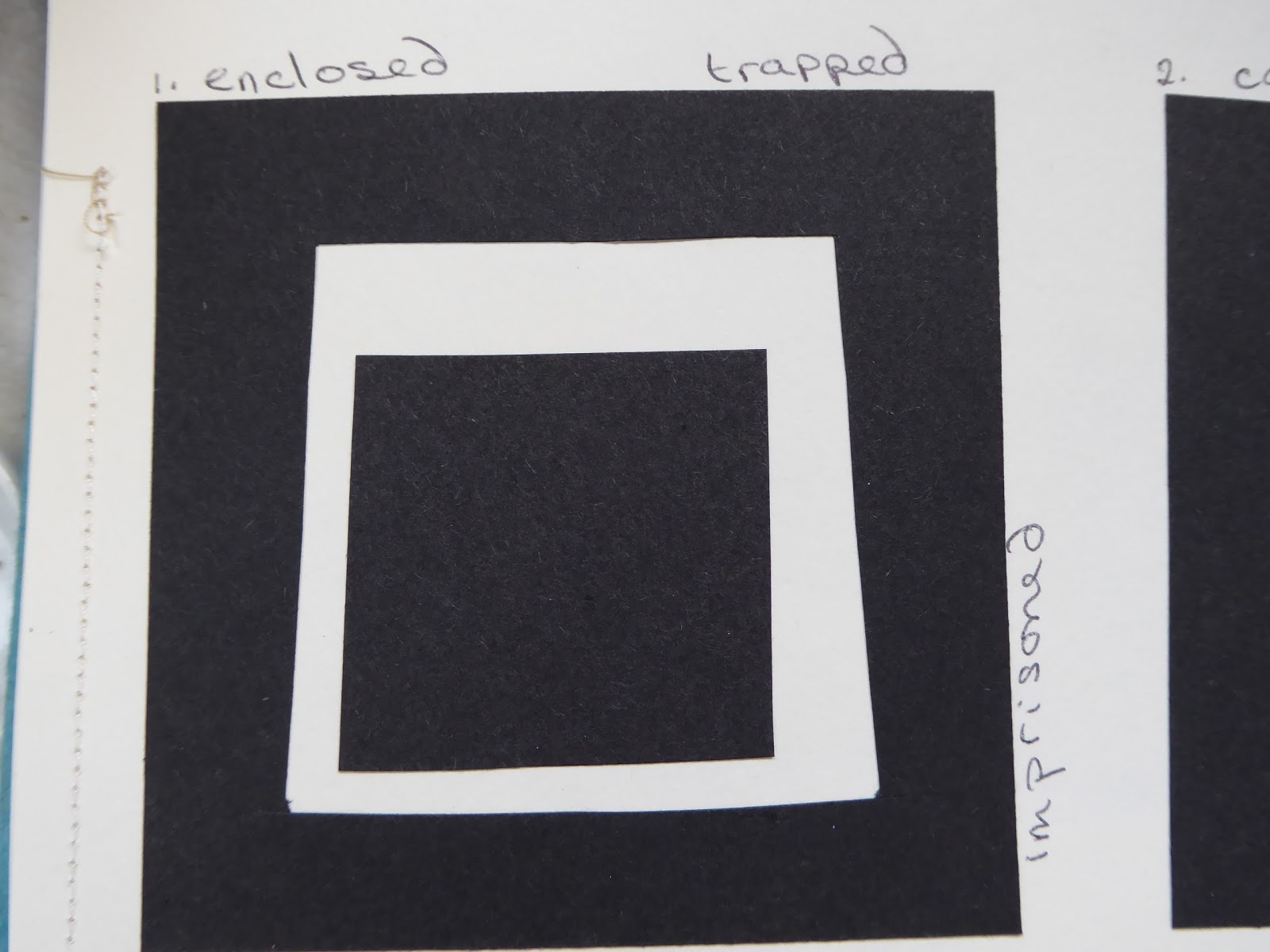
Our next task was to think of words which relate to our theme and then to interpret them using only black and white paper.

My list was as follows: beauty of the sea; melting; cracking; powerful; turbulent; threatening; overwhelming; hunger; terror; stressed; vulnerable; violent; panic as flames spread or ice melts; worry about the future; shattered; confusion.

Fig: 8:8 
Enclosed; trapped; imprisoned

Fig: 8:9 
confined; crushed; enclosed

Fig: 8:10 
Crushed; compressed

Fig: 8:11 
Cracked; fractured

Fig: 8:12
Entwined; mingling; rhythmical; gentle

Fig: 8:13 
Frenzied; vigorous

Fig: 8:14 
Crushed; compressed; pressure; stressed

Fig: 8:15 
Melting; peaceful

Fig: 8:16
Crushed; expelled; violent; vulnerable

Fig: 8:17 
Fractured; cracked; shattered; violent

Fig: 8:18 
Gentle; calm; peaceful; quiet

Fig: 8:19
Confused; frenzied; cracking; violent

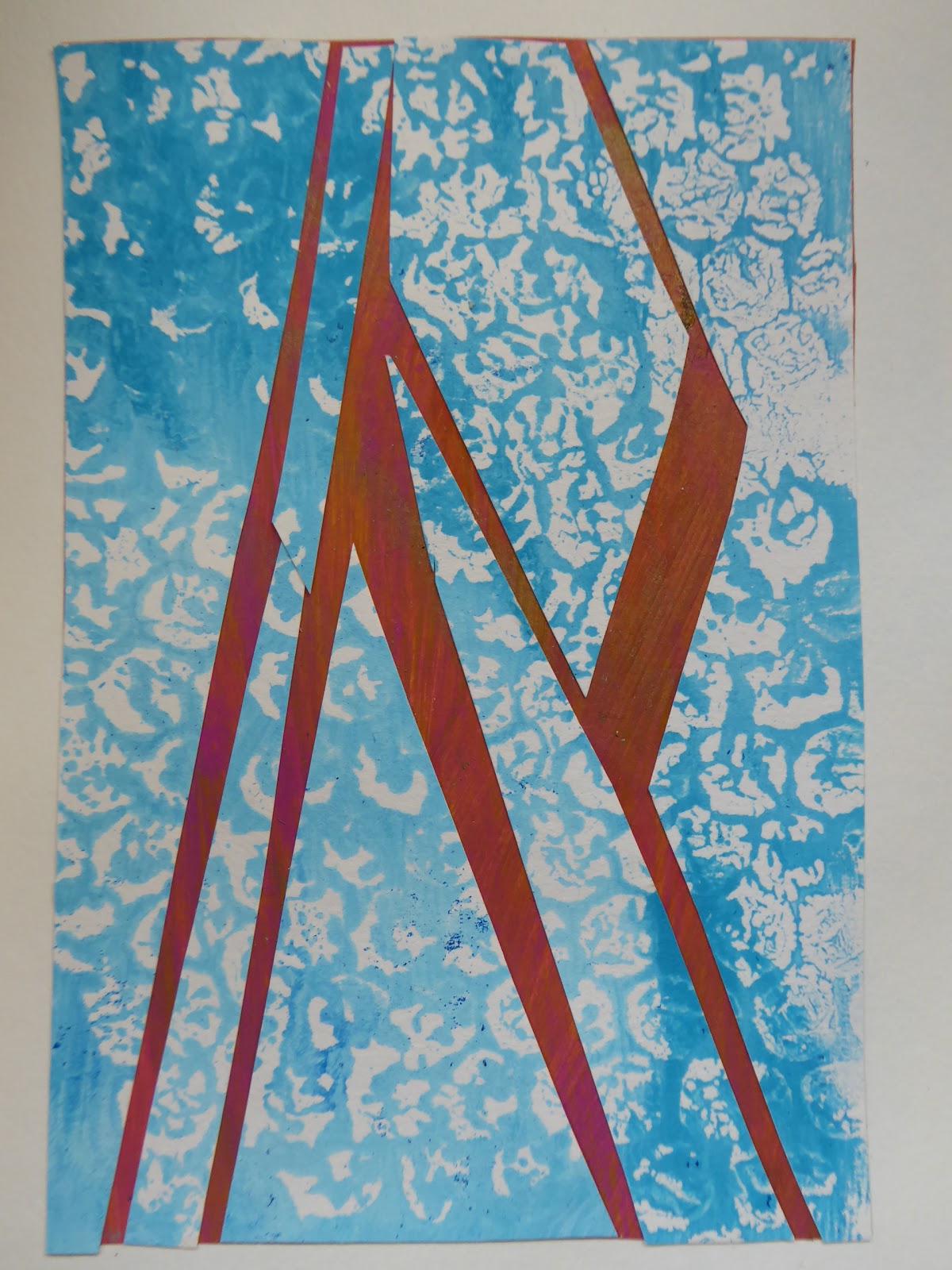
I then chose seven of these black and white images to enlarge slightly using coloured papers. I have used papers previously coloured for this and a previous module but they are mainly in my chosen colour palette of blues, white and oranges.

Fig: 8:20 
I like this sample very much and feel it could easily be developed into a final design to represent the cracking ice, turbulent seas/flood water and also the flames of the wildfires. It is definitely one that I will take forward into the next chapter

Fig: 8:21
This could represent the shifting ice floes as the ice melts and cracks, pushing sections out into the open seas.

Fig: 8:22
A more gentle design which could represent the ripples on the water or even fish swimming beneath the ice.

Fig: 8:23
More frenzied, cracking and disintegrating icebergs against a background of flames or simply the hot colours representing global warming in general.

Fig: 8:24
The 'orange' painted paper in this sample lends a smoky effect to the design which originally represented the feeling of being trapped so perhaps this is appropriate!

Fig:8:25
A development on representing conflict and confusion from Sian's examples in the module notes which seems appropriate to my theme, thinking of the wildlife caught in the fires and also on the disappearing ice masses in the Arctic and Antarctic.

Fig: 8:26
And finally a sample reflecting compression, thinking perhaps of how the ice caps melt from below and fall in on themselves.


Chapter 7: Dissolving fabric

I began this chapter by collecting a selection of dissolvable fabrics bought from Art Van Go, Colourcraft and Barnyarns at the Knitting and Stitching show in November last year. The samples don't show up on a photograph as, of course, they are all transparent, but here are my thoughts on the various materials.

a: Aquabond is a sticky soluble frilm. The front of the film is coated in a soluble glue and it is used to stick to 'tricky' fabrics e.g. knitted or delicate fabrics or velvet which might be prone to damage if using a hoop.
b: Romeo heavyweight is stable enough to use without a hoop. It is possible to draw a design onto the fabric with a water soluble pen or to put it through an inkjet printer when attached to a carrier sheet using low-tack adhesive.
c: Lightweight soluble film needs to be used in a hoop or used in more than one layer for greater stability. Again it is possible to draw or trace a design onto the film with a water soluble pen. It can be used underneath, on top of, or to sandwich embroidery or loose threads.
d: Solufleece is like a fine Vilene and needs to be used in a hoop or in multiple layers for greater stability.

Our next task was to work technical samples using each of the fabrics. I didn't work a technical sample on the Aquabond as this appears to have a particular use and would be used in connection with one of the other films.

Fig: 7:1


The top sample in the above image is worked on heavyweight Romeo, which I found was easy to stitch without a hoop, though I wasn't fond of the plastic feel. It also took quite a while to wash out. It does, however, make for a very stable sample.

The next sample is worked on Lightweight soluble film, which was stronger than I had expected when putting it into the hoop but it did tear under the needle whilst stitching. More like fabric than the Romeo and very easily rinsed away.

The third sample (4a in the image) is worked on Solufleece. I first tried this without a hoop as it felt like fabric but it puckered and gathered under the needle, giving a very shrunken finished piece.

The final sample (4b) is also worked on Solufleece, but this time in a hoop, which worked much better. It stitches like fabric and is very easy to rinse away afterwards.

We were then asked to work different stitches using just one type of fabric. I used Sian's key for the stitch methods:
1. Normal stitching; 2. Free machine stitch; 3. Open effect; 4. Dense effect; 5. In one direction; 6. In opposite directions; 7. In curved shapes; 8. Straight stitch; 9. Zig-zag stitch; 10. Cable stitch and 11. With trapped threads.
Fig: 7:2
Sample 1A in Fig. 7:2 uses 1, 6 and 9 - some threads were worked in a straight stitch, others in zig-zag, which made for a very stable sample.
2A uses 2, 8, 6 and 3
3A uses 2, 9, 6 and 3
4A uses 2, 4, 6 and 8
5A uses 2, 7, 8 and 3
6A uses 2, 6, 8 and 10
Fig: 7:3 
Sample 7A uses 2, 8, 10 and 11 ... and
Sample 8A uses 2, 7, 8 and 11

The next task was to produce a series of larger samples based on the drawings done in Chapter 1.

Fig: 7:4
When I began this section I realised that I had not yet worked a very solid piece of stitching so this sample is worked in crossing lines of straight stitch. I added the extra colours by way of contrast and thus it is really only loosely based on the original sample of acrylic paint sponged onto acetate. It is, however, an effective rendition of reflections on the sea's surface - especially echoing Van Gogh's painting (though it did use up a great deal of thread).
 
Fig: 7:5
I was unsure which way to mount this sample of spiralling straight stitch as I liked both sides equally. In the end I opted to put the reverse uppermost. I used a deep turquoise thread in the needle and yellow in the spool, and I think the reverse better echoes the frottage sample from Chapter 1, and again references the sunlight glinting on the water's surface.

Fig: 7:6

Sample 7:6 is worked with a spiralling straight stitch in a pale blue with meandering lines in dark blue which echo the ink marks in the painted sample. I really like the lacy effects achieved with this spiralling stitch and in different colours this could easily relate to jet trails in the sky. Using a cable stitch would further enhance that effect.

Fig: 7:7
 Sample 7:7 is worked with spiralling zigzag stitch connecting snippets of crystal organza in a paler blue and accurately echoes the bubble wrap prints from Chapter 1. Again, they look a little like the ripples on the surface of the water in some of my original photographs taken from the ferry on the way to Bute.

Fig: 7:8
 Sample 7:8 is meandering lines of zigzag stitch in a dark blue thread connecting fish-like shapes of hand dyed cotton fabric. More meandering lines, this time in straight stitch in a pale turquoise thread form a web (or net) of stitches to further hold the piece together. The inspiration for this came from the sample in Chapter 1 where acrylic paint was sponged over the edge of a torn piece of card onto acetate.

Fig: 7:9


The final sample is very much a case of waste-not, want not as this is the piece of fabric which the pieces for sample 7:8 were taken from. A much more solid piece which refers back to the oil pastel trapped between two piece of plastic and ironed in Chapter 1. As the fabric was going to hold this firm I just worked meandering lines across the piece to form lacy webs within the spaces.