Thursday, 18 January 2018

Chapter 5:2 Paper investigation

For this chapter we were asked to do several experiments with as many different types of paper as we could find. We were to tear, fold, crease and crumple each in turn to see what effects resulted.

 Fig. 2.1

 Fig. 2.2

 Fig. 2.3

Fig. 2.4

The labels on these scrunched up papers are hidden so reading left to right:
Top row: card; newsprint; lining paper
Centre: wrapping paper; kitchen roll; tissue
Bottom row: hand-made tissue; silk paper; architects tracing paper

 Fig. 2.5
Sample 1: Tissue paper hole punched with an oblong punch, then torn and layered

Fig. 2.6
Sample 2: Tracing paper strips cut with scallop edged scissors and overlapped 

 Fig. 2.7
Sample 3: Tracing paper cut with different scrapbooking scissors, patches and strips overlapped

 Fig. 2.8
Sample 4: Tracing paper run through the sewing machine without thread then torn into strips and overlapped

 Fig. 2.9
Sample 5: Pleated tissue paper strips and patches

Fig. 2.10
Sample 6: Tissue paper pleated in two directions
 
 Fig. 2.11
Sample 7: Scrunched tissue paper glued down to retain rough folds.

Fig. 2.12
Sample 8: Rolled and twisted strips of tissue paper
 
 Fig. 2.13
Sample 9: Tissue paper strips rolled and knotted

Fig. 2.14
Sample 10: Strip of tissue paper machine gathered along one edge and formed into a rough circle
 
 Fig. 2.15
Sample 11: Long strips of tissue paper machine gathered roughly down the centre and glued in place

Fig. 2.16
Sample 12: A large piece of tissue paper with four rows of machine stitch to gather up before gluing in place.

Some of these initial samples I think are already suggesting the textures on my trees but I'll play with them more in the next chapter.

Module 5: Texture in Landscape

Maybe I should have called this post 'My Love Affair with Trees'! I've loved trees for as long as I can remember ... vague memories of my hippie 'tree hugging' phase as a teenager. Established in our 'forever home' with a garden far too small to have a real life tree (the flowering cherry tree that was there had to go after much heart searching as it was causing cracks in the house wall), we set about creating our very own bonsai arboretum. I have oak trees which are no more than 10" tall grown from acorns which we planted ourselves, a crab apple tree 8" tall and 35 years old which is smothered in blossom every spring and produces tiny crab apples every autumn, a tiny quince which is the first to bloom each year with beautiful red flowers, a gingko, a selection of maples... well, you get the idea.

 Maple bonsai

Crab apple bonsai

Everywhere I go I take photographs of trees so when I saw the topic for Module 5 - Texture in the Landscape - I immediately knew what my subject would be! So tree bark it is.

Fig. 1.1
 
Fig. 1.2


Fig. 1.3

Fig. 1.4

Fig. 1.5

Fig. 1.6

My first job was to narrow down the images that I would use as inspiration for my work and tried to pick out some of the trees with the most interesting textures. We were asked to zoom in on the particular area of interest and to manipulate the images in some way so as to emphasise the texture. It was then that I hit my first obstacle ... the last update of Windows 10 had rendered my copy of Photoshop Elements unusable! I found a couple of free photo editing programs online but they weren't really doing what I wanted. I waited to see if Santa would bring me an up-to-date copy of Photoshop and he didn't let me down.

 Fig. 1.7

 Fig. 1.8

 Fig. 1.9

 Fig. 1.10

 Fig. 1.11

 Fig. 1.12

 Fig. 1.13

Fig. 1.14


Wednesday, 8 November 2017

Three artists and admin


Authentication


Health and safety:

·         Take normal levels of care whilst using electrical equipment i.e. don't leave electrical cables trailing across floor or work space.
·         Equipment for dyeing and paper-making should be kept separate from general kitchen equipment to avoid contamination of foodstuffs.
·         Clean up any spillages immediately and do not allow water to come into contact with electrical appliances.
·         Wash all equipment thoroughly after use to ensure they are clean and ready for action next time you come to use them.
·         When bonding fabrics ensure that baking parchment is used beneath and on top of the fabrics being bonded to prevent damage to your iron.
·         Work in a well-ventilated space with water close at hand when using candles/matches and other heat tools.
·         Work on a heat-resistant surface when using heat tools.
·         Use the correct heat for the fabric being used when using an iron, and keep fingers out of the way – especially when using steam.
·         Cover all surfaces with plastic sheeting as well as newspaper when using Brusho inks, dyes and other paints.
·         Use a cutting mat when using a craft knife to cut papers, together with a non-slip ruler. Replace the blade regularly to ensure a clean cut and always put the cap back when it is not in use.
·         Use a darning foot and embroidery hoop when doing free machine embroidery to protect your fingers and change the needle regularly.
·         Always, always keep pins, needles and other sharp items away from pets and young children. 

Storage of materials:
Design work in progress: kept tidily in workspace away from sun, dust and moisture. Embroidery in progress is kept in a pocket/folder together with the relevant threads and needles.
Completed embroidery: Placed in sketchbook or display folder.
Completed design work: Placed in sketchbook
Inks and paints: upright in the allocated drawer in my garage workroom.
Other items - glue, bleach etc: Upright in wall cupboard in garage workroom out of reach of pets and children.
Fabrics: Those required for the current project are kept in a basket together with threads and other items so they are to hand when needed.
Sewing machine: Kept on sewing table in my sewing room with its cover in place and wires stored neatly.
Other electrical equipment (Iron, blender etc): Allowed to cool after use then stored on the workbench in my garage workroom.

Costings
Blender ...... £18.99
Linen scrim ..... £3.75
Other fabric and threads from my existing stock ... estimated cost approx £6

 Timings
Chapter 1 -  2 hours
Chapter 2 -   6 hours
Chapter 3 -   1.5 hours
Chapter 4 -   8 hours
Chapter 5 -   7 hours
Chapter 6 -   12.5 hours
Chapter 7 and 8 - 8 hours
Chapter 9 -   3 hours
Chapter 10 - 6 hours
Chapter 11 - 14 hours

Sunday, 5 November 2017

Making a book


In the process of making the final book a few things still changed, despite all the sampling and planning, though I think this is perhaps inevitable as some ideas developed as I went along and others simply didn't work out.

I began by preparing the three sets of pages for my book. (I must apologise for the camera cord  which I hadn't noticed was in the frame when I took these photographs, and hope it doesn't obliterate too much of the image).

Fig.1

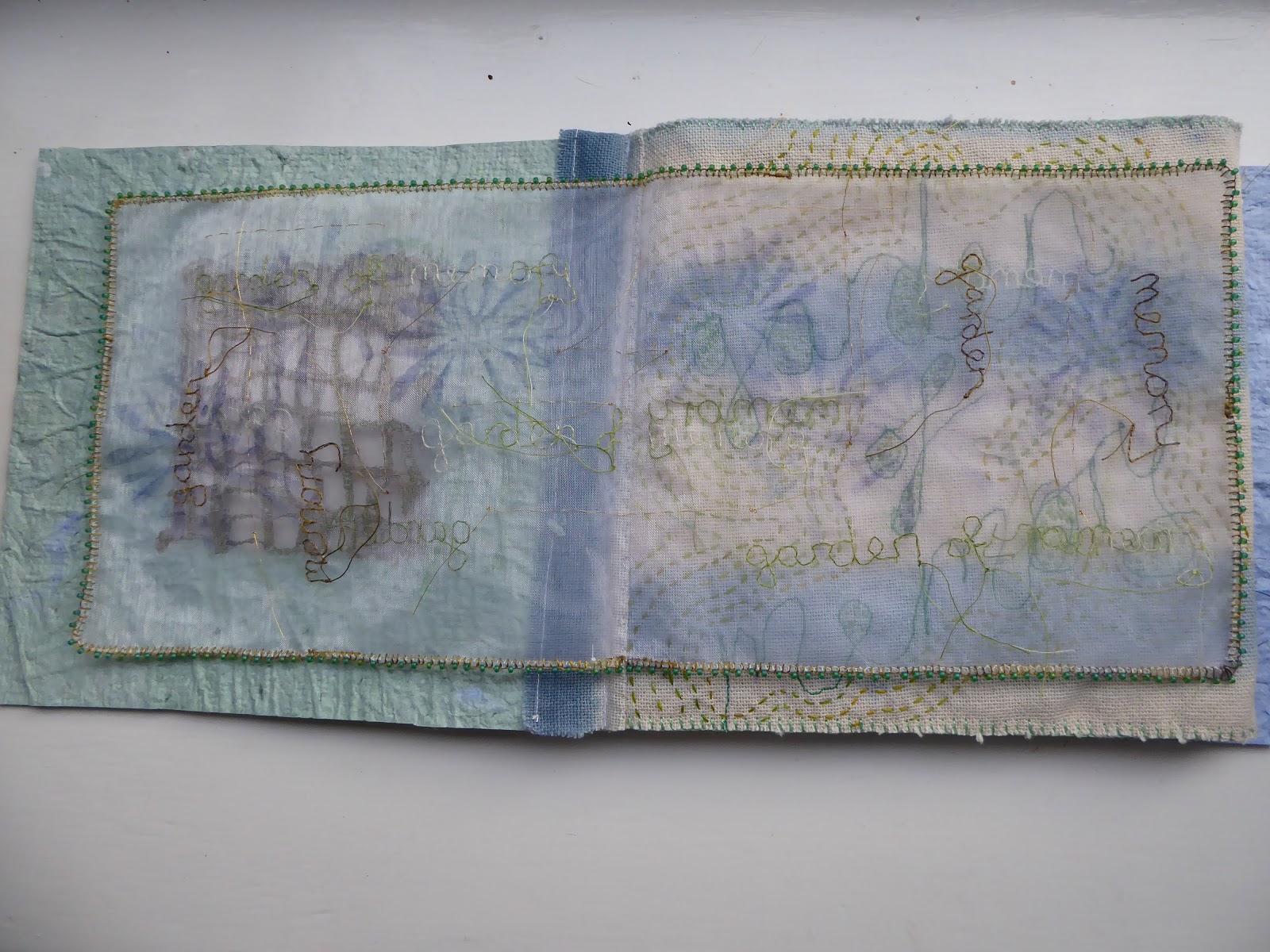
For the first internal page I stamped my agapanthus image onto two sheets of organza fabric before stitching one piece with the words 'garden of memory' and the other with the words 'garden' and 'memory' randomly across the fabric. The intention was to mimic the lettering sample No. 10 in Chapter 2. I left the loose ends of my threads floating across the page. Once the stitching was complete I stitched the two pieces of fabric together around the edges with a bead decorated buttonhole stitch.
 
Fig. 2

The second internal page was stitched in a very similar way to the first but this time I printed a photograph I had taken of the gold ballroom in Pushkin Palace in St Petersburg onto a third piece of organza. I then cut this into strips and bonded it onto a second piece of organza before stitching it with the words 'palace' and 'dreams'. The other side of this page has the words 'palace of dreams' embroidered randomly over it.
 Fig. 3
I tried many different arrangements of my family photographs in an attempt to make a collage of the faces, but as they are all different sizes and poses, it proved impossible to make them look as good as I needed them to. In the end I admitted defeat and decided to have each photo printed onto a separate page of calico.
Fig. 4
I machine stitched a frame around each photograph then hand embroidered my quotation throughout the pages.
 Fig. 5
I added rows of decorative machine stitching onto some of the pages

 Fig. 6
and stitched the pages together at the edges with a buttonhole stitch. I didn't add beads this time as I felt there was already enough decoration on these pages.

 Fig. 7
I then sewed the pages together into a simple eight page pamphlet on the machine.

 Fig. 8

Fig. 9
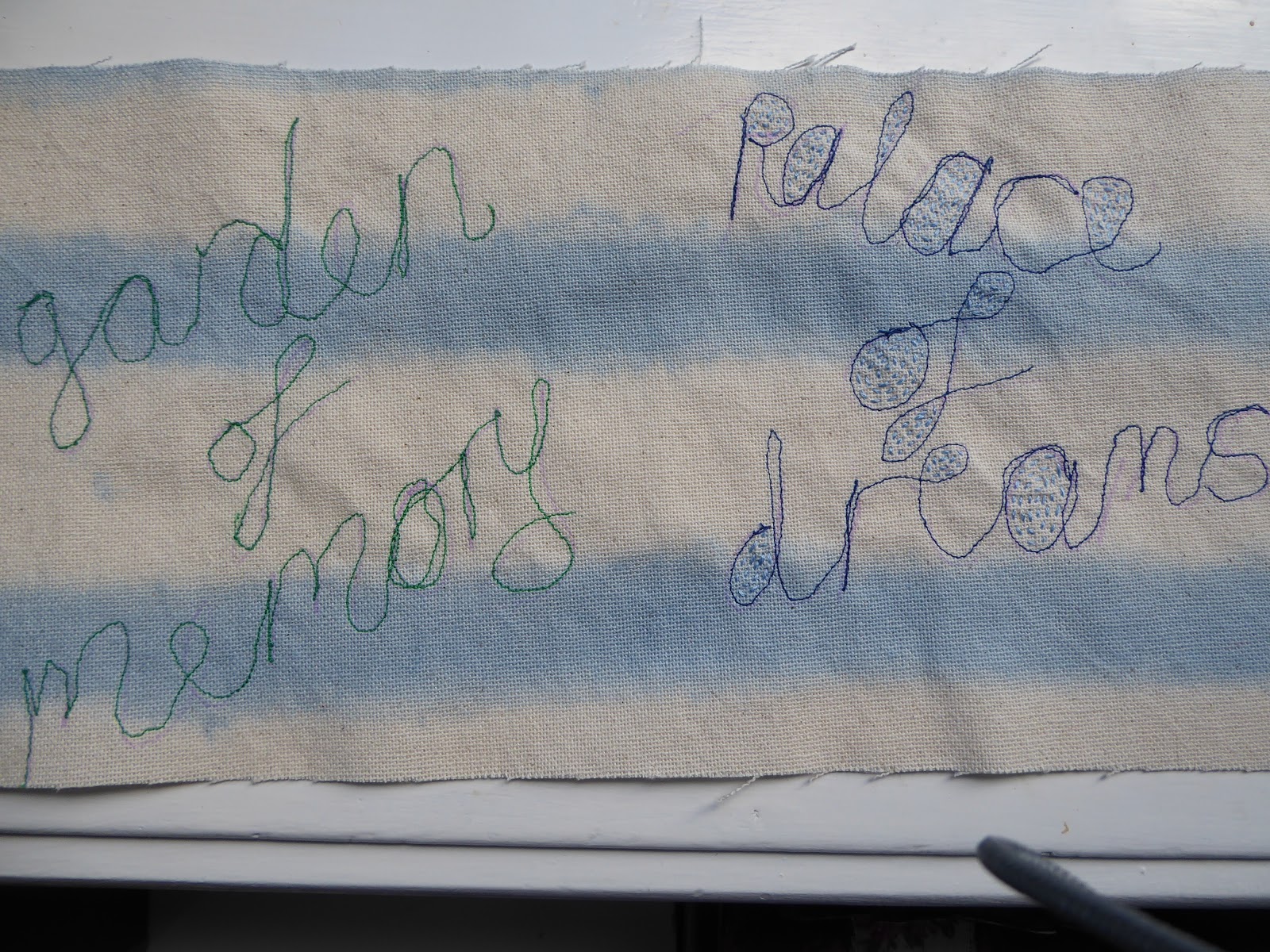
Figures 8 and 9 show the dividing pages of the book - a piece of linen onto which I painted wide blue stripes with cold water dye to reference lined writing paper. After a couple of practice attempts I decided to bite the bullet and machine stitch my quote. In Fig. 8 you can see that I have started to work seed stitches into the centres of some letters to echo Sample 19 of my lettering samples in Chapter 2.

 Fig. 10
The outer covers are made from hand made paper, each bonded to a piece of machine embroidered pulled work. Fig. 10 shows the cover which sits over the 'Palace of Dreams' side of the finished book. In order to reference the palace I machine stitched over a piece of canvas from which a grid of threads has been removed. I then worked hand embroidery over the grid in some areas.

Fig. 11
Fig. 11 shows the cover which sits over the 'Garden of Memory' side of the book and has a much more organic panel embedded in the paper, this time made from a piece of machine embroidered scrim to reference a tangle of stems on a trellis.
Figures 12-21 show the completed book as I turned the pages.

Fig. 12
 
Fig. 13
 
Fig. 14

Fig. 15
I stitched lines of running stitch around the words on the linen pages.

Fig. 16

Fig. 17

Fig. 18

Fig. 19

Fig. 20

Fig. 21

Fig. 22

Evaluation of final piece of work
Overall I'm very happy with my finished book, though were I to make it again I would probably enclose a piece of pelmet vilene between the two linen pages to stiffen the back. The book works well in the hand but trying to stand it up in order to display it for the purposes of this blog proved tricky with the soft centre. 
 
That being said, however, I feel that the book I've made uses many of the techniques learned throughout this module. I had never made paper before but I found it fun to do and ended up with some interesting papers to use in sketchbooks and the like in future. I had done some pulled thread embroidery by hand in the past but never on the machine, and I thoroughly enjoyed exploring this technique, making some interesting discoveries whilst working with canvas along the way. I had also never plucked up the courage to try free machining lettering before and was pleasantly surprised by the results I achieved.

I also feel that for this module I finally embraced the process of exploring and experimenting with a technique through sampling without having a fixed finished piece in my mind and I think that the book has benefited from this. Without all the sampling I would probably have fallen back on tried and tested methods of book making that I have used in the past. I'm delighted that I now have another book to add to my collection - one that is different from all the others - and one which adds to my work on my family history.